
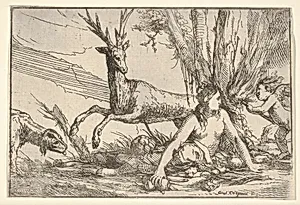
Earth, represented by Cybele seated at the base of a tree with fruits of the earth spread before her, a cupid with a torch approaches from the right, a stag and hound look toward Cybele from the left, from "The Elements"
Giulio Carpioni, 1640–60
Giulio Carpioni, 1640–60
In the mid-17th century, Italian artist Giulio Carpioni crafted this enchanting etching as part of his series *The Elements*, a Baroque-era celebration of nature's fundamental forces through mythological allegory. Dated between 1640 and 1660, *Earth, represented by Cybele* the Roman goddess of the earth—often revered as Magna Mater—seated majestically at the base of fruit-laden tree, symbolizing fertility and abundance. Fruits spread before her evoke the earth's bountiful harvest, a nod to classical antiquity's reverence for Cybele as protector of crops and wild beasts. From the right approaches a playful Cupid bearing a torch, perhaps hinting at the transformative fire that stirs earth's vitality, while a stag and hound gaze toward her from the left, representing the untamed wilderness under her domain. Carpioni's etching technique—scratching acid-resistant lines into a metal plate—allowed for intricate details in the animals' fur, the goddess's flowing drapery, and the textured bark, showcasing the medium's precision in reproducing painterly effects on a modest 4 1/8 × 6 1/4-inch sheet. This print, now in the Metropolitan Museum of Art's Drawings and Prints collection, reflects the Baroque fascination with dynamic compositions and symbolic depth, blending pagan mythology with 17th-century natural philosophy. Visitors will appreciate its whimsical yet profound tribute to earth's nurturing power.