
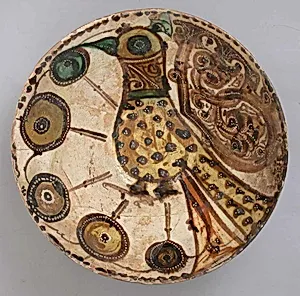
Earthenware Bowl with White slip and Polychrome Decoration
Unknown Artist
11th century
Medium
Earthenware; white slip with polychrome slip decoration under transparent glaze
Dimensions
H. 4 7/16 in. (11.3 cm) Diam. 11 5/8 in. (29.5 cm) Wt. 37.4 oz. (1060.4 g
Classification
Ceramics
Department
Islamic Art
Museum
Metropolitan Museum of Art, New York, NY
Credit
Gift of Mr. and Mrs. Lester Wolfe, 1965
Accession Number
65.270.4
Rights
Public Domain
Tags
Art Historical Context
This exquisite 11th-century earthen bowl, hailing from the Islamic world, exemplifies the artistry of everyday ceramics during a vibrant era of cultural flourishing. Crafted with a white slip base and adorned with polychrome slip decoration under a glaze, it features motifs of birds—a common symbol in Islamic art evoking grace, freedom, and the natural world. Measuring 4 7/16 inches high 11 5/8 inches in diameter, substantial 37.4-ounce weight suggests it was designed for practical use, perhaps serving food or water in a prosperous household. The technique of slip decoration, where pigmented slips are trailed onto the unfired clay before glazing, allowed artisans to create bold, colorful patterns with remarkable precision. This method, prominent in 11th-century Islamic pottery production, highlighted the region's mastery of low-fired earthenware, making luxury aesthetics accessible beyond elite metals or glass. Such bowls were traded widely across the Islamic realm, from Persia to the Mediterranean, blending utility with aesthetic delight. Today, this gift from Mr. and Mrs. Lester Wolfe (1965) graces the Metropolitan Museum of Art's Islamic Art collection, offering a window into the ingenuity of anonymous craftsmen whose work bridged art and daily life.