
Ebisu and Daikoku; Two of the Seven Gods of Good Fortune
19th century
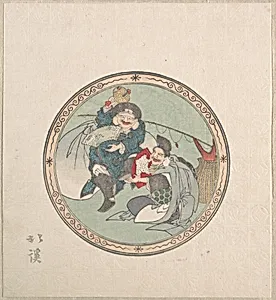
Medium
Part of an album of woodblock prints (surimono); ink and color on paper
Dimensions
7 15/16 x 7 1/4 in. (20.2 x 18.4 cm)
Classification
Prints
Culture & Period
Japan · Edo period (1615–1868)
Department
Asian Art
Museum
Metropolitan Museum of Art, New York, NY
Credit
H. O. Havemeyer Collection, Bequest of Mrs. H. O. Havemeyer, 1929
Accession Number
JP2248
Rights
Public Domain
Tags
Art Historical Context
In the vibrant world of Edo-period Japan (1615–1868), Totoya Hokkei a skilled ukiyo-e print and pupil of the famed Katsushika Hokusai, crafted this charming woodblock print featuring Ebisu and Daik, two of the beloved Seven Gods of Good Fortune (Shichifujin). Part of a luxurious surimono album—privately commissioned prints often exchanged as New Year's greetings—this intimate 19th-century work measures just under 8 by 7 inches, showcasing Hokkei's mastery of delicate ink and color on paper. Ebisu, the god of fishermen and commerce, and Daikoku, patron of wealth and rice, embody prosperity and abundance in Japanese folklore. These jolly deities, carried on a giant mallet or fish, were immensely popular talismans for merchants and households, reflecting the era's booming urban culture and love for auspicious imagery. Surimono like this one stand out for their refined techniques: subtle mica flecks for shimmer, embossed textures, and poetic inscriptions, elevating them beyond standard ukiyo-e to artisanal treasures. Housed in the Metropolitan Museum of Art's Asian Art collection from the H. O. Havemeyer bequest, this print invites visitors to ponder Japan's harmonious blend of spirituality and artistry, where even gods smile with everyday charm.
About the Artist
Totoya Hokkei · 1780–1850
Totoya Hokkei (魚屋 北渓, 1780–1850), born Iwakubo Tatsuyuki in Edo (modern Tokyo), began his life as a humble fishmonger in the Yotsuya Samegahashi district, a trade reflected in his art name "Totoya," meaning fish shop. He transitioned to art through rigorous training, first studying under Kanō Yōsen'in Korenobu, head of the Kobikichō branch of the prestigious Kanō school, where he honed landscape p...