
Ecce Homo
ca. 1520–25
Medium
Wool, silk, silver-gilt thread (17-18 warps per inch, 7-8 per cm.)
Dimensions
53 × 40 in. (134.6 × 101.6 cm)
Classification
Textiles-Tapestries
Culture
Netherlandish, Brussels
Department
European Sculpture and Decorative Arts
Museum
Metropolitan Museum of Art, New York, NY
Credit
Gift of Jacques Seligmann, 1906
Accession Number
06.301
Rights
Public Domain
Tags
Art Historical Context
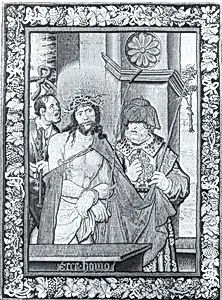
Behold the poignant "Ecce Homo," a masterful Netherlandish tapestry designed by Quentin Metsys around 1520–25 and woven in Brussels, the unrivaled center of European tapestry production during the Renaissance. This work depicts the biblical moment when Pontius Pilate presents the crowned Jesus Christ to the crowd, saying "Ecce Homo" ("Behold the Man"). Metsys, a leading Antwerp painter of the Northern Renaissance known for his meticulous realism and religious themes, likely created the detailed cartoon (design) that weavers brought to life. Adorned with symbolic grapes—evoking the Eucharist and Christ's blood—and delicate flowers, the scene blends spiritual devotion with naturalistic beauty. Crafted from luxurious wool, silk, and shimmering silver-gilt thread (with a fine 17–18 warps per inch), this 53 × 40-inch tapestry exemplifies the haute lisse technique of high-warp weaving, prized for its precision and jewel-like quality. Such opulent textiles were status symbols for nobility and clergy, adorning palaces and cathedrals to inspire awe and contemplation. Today, this rare survival graces the Metropolitan Museum of Art, gifted in 1906. It highlights Brussels' dominance in the lucrative tapestry trade, which fueled artistic innovation across Europe and preserved Metsys' vision for generations of visitors.