
Ecce Homo
Maarten van Heemskerck, 16th century
About this artwork
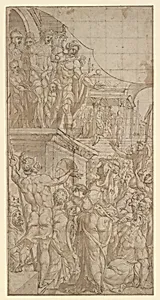
Maarten van Heemskck's *Ecce Homo*, a poignant 16th-century drawing captures the biblical moment when Pontius Pilate presents the bound Christ to the crowd, uttering "Behold the Man This Netherlandish artist, active during the Renaissance, drew inspiration from his travels to Rome, blending Northern precision with Italianate grandeur. The work exemplifies van Heemskerck's skill in religious iconography, Christ as a muscular male nude to emphasize his humanity and suffering—a bold motif in devotional art of the era. Rendered in pen and brown ink with brush and brown wash, and squared in black chalk for transfer to a larger painting or fresco, the sheet measures 16 5/16 x 8 1/4 inches. These mixed-media techniques allowed for intricate line work, subtle tonal modeling, and preparatory accuracy, hallmarks of Renaissance draftsmanship. The brown wash adds dramatic chiaroscuro, heightening the emotional intensity of Christ's vulnerable form. Acquired by the Metropolitan Museum of Art in 2003 through the David T. Schiff Gift, this drawing from the Drawings and Prints department offers a window into van Heemskerck's workshop practices and the era's fascination with classical anatomy in Christian subjects. Visitors will appreciate its raw power, bridging faith, artistry, and humanism.