
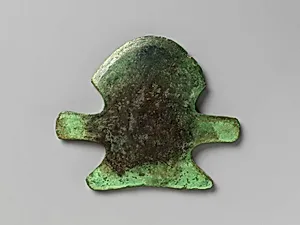
Eccentric Anthropomorph
Unknown Artist
1500–1000 BCE
Medium
Copper
Dimensions
4 1/2 x 5 9/16 in. (11.4 x 14.1 cm)
Classification
Metalwork
Culture
Nepal (Kathmandu Valley)
Department
Asian Art
Museum
Metropolitan Museum of Art, New York, NY
Credit
Samuel Eilenberg Collection, Bequest of Samuel Eilenberg, 1998
Accession Number
2001.433.9
Rights
Public Domain
Art Historical Context
Nestled in the ancient Kathmandu Valley of Nepal, this *Eccentric Anthropomorph dates to the enigmatic period between 1500 and 1000 BCE, a time when early metalworking traditions began to flourish in South Asia. Crafted from copper by an unknown artist, this metalwork piece—measuring just 4½ x 5⅜ inches—likely represents a stylized human-like figure, its "eccentric" form hinting at ritual or symbolic significance in prehistoric Nepalese culture. Such artifacts from the region offer rare glimpses into pre-Buddhist and pre-Hindu spiritual practices, where anthropomorphic objects may have served as votive offerings, amulets, or shamanic tools. The use of copper underscores the technological prowess of Kathmandu Valley artisans during the late Bronze Age transition, when lost-wax casting or hammering techniques enabled intricate forms from this malleable metal. Portable and intimate in scale, it reflects a worldview blending human and supernatural realms, bridging everyday life with the divine. Housed in the Metropolitan Museum of Art's Asian Art Department as part of the Samuel Eilenberg Collection (bequeathed in 1998), this piece invites us to ponder the roots of Nepal's enduring artistic heritage, where metalwork laid the foundation for later gilded bronzes and temple sculptures.