
Écorché: Three Studies of a Male Cadaver
n.d.
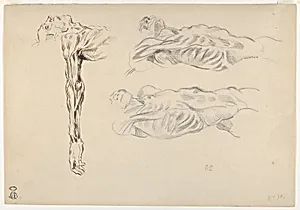
Medium
Pen and brown ink, graphite
Dimensions
Overall: 9 5/8 x 14 1/16 in. (24.4 x 35.7 cm)
Classification
Drawings
Department
Drawings and Prints
Museum
Metropolitan Museum of Art, New York, NY
Credit
Gift from the Karen B. Cohen Collection of Eugène Delacroix, in honor of David and Constance Yates, 2013
Accession Number
2013.1135.13
Rights
Public Domain
Tags
Art Historical Context
Eugène Delacroix, towering figure of French Romanticism, masterfully captured the human form in *Écorché: Three of a Male Cadaver*, a poignant drawing from his extensive sketchbooks. Rendered in pen and brown ink with graphite, this undated sheet (approximately 9⅝ × 14⅛ inches) presents three views of a flayed male, revealing the intricate musculature beneath the skin Écorché studies like this were essential tools for artists in the 19th century, allowing them to dissect and understand anatomy firsthand, often from cadavers, to infuse their works with lifelike dynamism. Delacroix's Romantic style emphasized emotion and movement, and these precise yet expressive drawings exemplify his technical prowess. The fluid ink lines and subtle graphite shading model the body's contours with remarkable clarity, highlighting tendons, muscles, and skeletal structure. Such studies informed the vigorous figures in his iconic paintings, like *Liberty Leading the People* (1830), bridging raw anatomical study with artistic passion. Housed in the Metropolitan Museum of Art's Department of Drawings and Prints, this work was a gift from the Karen B. Cohen Collection of Eugène Delacroix in 2013. It invites visitors to appreciate the gritty dedication behind Romantic masterpieces, reminding us that great art often begins with unflinching observation of life's raw forms.
About the Artist
Eugène Delacroix · 1798–1863
Eugène Delacroix (1798–1863) stands as the defining figure of French Romanticism and a pivotal bridge to modernism. Born in Charenton-Saint-Maurice near Paris, he came from distinguished lineage—his mother descended from the prestigious Oeben-Riesener furniture dynasty, while persistent speculation suggested the statesman Talleyrand may have been his biological father, a theory supported by physic...