
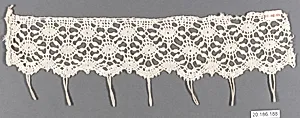
Edging
Unknown Artist
first half 16th century
Medium
Bobbin lace
Dimensions
L. 10 1/2 x W. 3 inches (26.7 x 7.6 cm)
Classification
Textiles-Laces
Culture
Italian, Genoa
Department
European Sculpture and Decorative Arts
Museum
Metropolitan Museum of Art, New York, NY
Credit
Rogers Fund, 1920
Accession Number
20.186.188
Rights
Public Domain
Art Historical Context
This delicate bobbin lace edging, in Genoa, Italy, during the first half of 16th century, the Renaissance mastery of textile arts. Measuring just 10½ 3 inches, this strip was likely designed as a luxurious trim for garments, linens, or ecclesiastical vestments, showcasing Genoa's prominence as a leading lace-making hub. In an era when Italy dominated Europe's luxury crafts, Genoese lace symbolized wealth and refinement, often adorning the attire of nobility and clergy. Bobbin lace, the medium here, involved skilled artisans twisting and intertwining fine silk or linen threads around weighted bobbins on a cushioned pillow, guided by pins to form intricate geometric or floral patterns. Unlike needle lace, this technique allowed for bolder, more sculptural designs with a distinctive transparency and texture. Such pieces highlight the anonymous yet virtuoso labor of lace makers, whose work blended mathematical precision with artistic flair. Today, preserved through the Rogers Fund at The Metropolitan Museum of Art, this edging offers a tactile glimpse into Renaissance decorative arts, reminding us how everyday textiles embodied cultural prestige and technical innovation.