
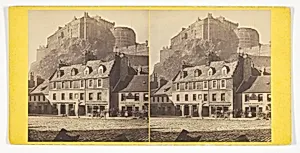
Edinburgh Castle
1867
Medium
Albumen print, stereo
Dimensions
Each image: 8.1 × 7.5 cm (3 1/4 × 3 in.); Card: 8.5 × 17.6 cm (3 3/8 × 6 15/16 in.)
Classification
photography
Department
Photography and Media
Museum
Art Institute of Chicago
Accession Number
198464
Rights
Public Domain
Art Historical Context
Archibald Burns’s 186 stereoscopic albumen print offers a striking view of Edinburgh Castle, one of Scotland’s most iconic landmarks. Created as a stereo card—two nearly identical images mounted side by side—the photograph was designed to be viewed through a stereoscope, producing a vivid-dimensional effect that brought distant architecture vividly to life for 19th-century audiences. Each small image measures just over three inches square, yet together they capture the castle’s imposing silhouette with remarkable clarity and depth. Albumen prints, made by suspending silver salts in egg-white emulsion, were the dominant photographic process of the Victorian era and prized for their fine detail and rich tonal range. Burns, a Scottish photographer active in Edinburgh, used this medium to document the city’s historic sites at a time when photography was rapidly becoming both a commercial enterprise and an artistic pursuit. The stereo format itself reflects the era’s fascination with optical technology and “armchair travel,” allowing viewers to experience places they might never visit in person. Today, this work in the Art Institute of Chicago’s collection reminds us how early photographers blended technical innovation with a desire to preserve cultural heritage. Burns’s careful framing highlights the castle’s medieval grandeur while demonstrating photography’s emerging power to shape public perception of history and place.