
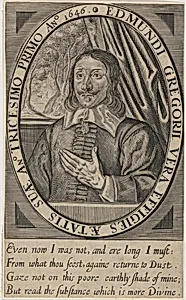
Edmund Gregory
published 1649
Medium
engraving
Dimensions
sheet: 12.3 × 7.5 cm (4 13/16 × 2 15/16 in.)
Classification
Department
CG-E
Museum
National Gallery of Art, Washington, D.C.
Credit
Rosenwald Collection
Accession Number
1951.11.441
Rights
Public Domain
Art Historical Context
This delicate engraving by William Marshall, published in 1649, offers a glimpse into the world of seventeenth-century English printmaking. Measuring just over four inches tall, the small sheet was likely created as a portrait or book illustration, reflecting the era’s growing demand for affordable, reproducible images. Marshall, a prolific engraver active during the English Civil War and Interregnum, specialized in capturing the likenesses of scholars, clergy, and public figures for a widening audience of readers. The choice of engraving as a medium was significant in this period. Unlike paintings reserved for the wealthy, prints allowed images to circulate widely, preserving faces and ideas across time and distance. Created in the very year of King Charles I’s execution, the work sits at a moment of profound political and cultural change in Britain, when printed portraits helped shape public memory and identity. Today, this impression in the National Gallery of Art’s Rosenwald Collection invites us to appreciate both the technical precision of Marshall’s burin work and the democratic spirit of early modern print culture.
About the Artist
William Marshall · 1569–1677
**William Edgar Marshall (1837–1906)** was a preeminent American engraver and portrait painter, renowned for his meticulous line engravings on steel that captured the dignity and character of his subjects. Born in New York City to Scottish parents, Marshall began his career young, apprenticing at age seventeen in a watch-case factory before honing his skills engraving portraits at the U.S. Treasur...