
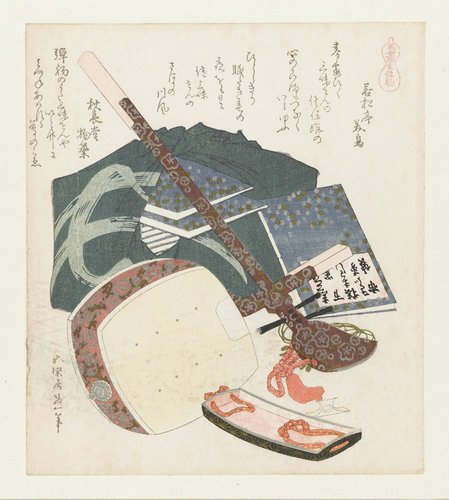
Een serie met paarden
Medium
nishikie, with metallic pigments and blindprinting
Dimensions
206; 183
Rights
Public Domain
About this artwork
nishikie, with metallic pigments and blindprinting
Art Historical Context
Katsushika Hokusai, the legendary Japanese artist of the Edo period (1760–1849), created *Een serie met paarden ("A Series with Horses") in 2. Renowned for his ukiyo-e woodblock—depicting the "floating world" of everyday life nature, and fantasy—this compact work (206 × 183 mm) likely belongs to one of Hokusai's series, showcasing his fascination with animals and dynamic forms. During the early 19th century, ukiyo-e prints like this democratized art in Japan, adorning homes and appealing to urban audiences amid strict isolationist policies. Rendered in nishikie ("brocade picture") technique, the print employs multiple woodblocks for vivid, layered colors, elevating it beyond standard monochrome ban. Metallic pigments lend a shimmering, jewel-like quality, evoking opulence, while blindprinting (gofun embossing) adds subtle texture and depth without ink—innovative methods that highlight Hokusai's mastery of printmaking. These luxurious effects were prized in private commissions, blending artistry with craftsmanship. Hokusai's influence endures, inspiring global artists from Van Gogh to modern designers. This piece captures the era's cultural vibrancy, where horses symbolized power and grace in Japanese folklore, inviting visitors to appreciate the print's intricate beauty up close.
About the Artist
Katsushika Hokusai · 1760–1849
Katsushika Hokusai (1760-1849) stands as one of history's most influential artists, a Japanese master who revolutionized the ukiyo-e woodblock print tradition and profoundly shaped Western art. Born in the Katsushika district of Edo (modern-day Tokyo) to an artisan family, Hokusai lived through nearly nine decades of extraordinary creative evolution, adopting over thirty different artistic names t...