
Een van vier zoutvaten
Medium
casting
Dimensions
6.1; 5.2; 6.1; 105
Rights
Public Domain
About this artwork
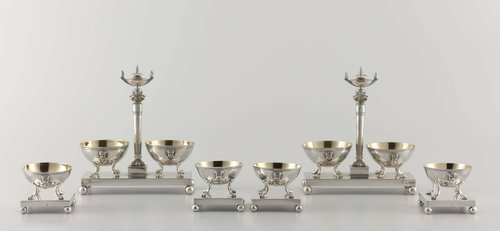
Half-bolvormig bakje op vier klauwpootjes, staande op een vierkante plaat, die op vier balvormige klauwpootjes rust. Het bakje is aan de binnenzijde verguld. Gemerkt en gedateerd.
Art Historical Context
**Een van vier zoutvaten (One of Four Salt Cell)** *Francois Marcus Simons, 180* *Cast metal with interior gilding, h 5.2 cm × w c. 6.1 cm × d c. 6.1 cm × w 105 g* This delicate salt cellar, one of a matching set of four crafted by Dutch silversmith Francois Marcus in 1803, the refined elegance of early 19th-century European tableware. Its half-hemispherical bowl rests gracefully on four claw feet, elevated by a square base supported on ball-shaped claw feet—a design motif evoking neoclassical motifs inspired by ancient Greco-Roman forms. The interior gilding adds a luxurious shimmer, protecting the metal while enhancing its opulence for dining rituals. Cast in metal and meticulously marked with the artist's hallmark and date, this piece highlights Simons' mastery of casting techniques, which allowed for intricate detailing on such a petite scale (just over 5 cm tall). Salt cellars like this were prized status symbols in affluent Dutch households, where salt's scarcity made it a table centerpiece symbolizing hospitality and wealth amid the Napoleonic era's shifting fortunes. Today, it offers a glimpse into everyday luxury, blending functionality with artistry in the grand tradition of silversmithing. (198 words)