
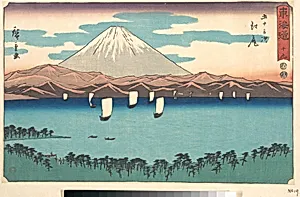
歌川広重画 東海道 十九 五十三次 江尻|Ejiri, Number 19, from the series Fifty-Three Stations of the Tōkaidō Road (Tōkaidō gojūsan tsugi), also known as the Clerical Script Tōkaidō (Reisho Tōkaidō)
1847–52
Medium
Woodblock print
Dimensions
Overall: 8 3/4 x 13 3/4in. (22.2 x 34.9cm)
Classification
Prints
Culture & Period
Japan · Edo period (1615–1868)
Department
Asian Art
Museum
Metropolitan Museum of Art, New York, NY
Credit
The Francis Lathrop Collection, Purchase, Frederick C. Hewitt Fund, 1911
Accession Number
JP769
Rights
Public Domain
Tags
Art Historical Context
Utagawa Hiroshige’s *Ejiri, Number 19* captures a tranquil coastal scene from one of Japan’s most celebrated travel routes. Created between 1847 and 1852 as part of the *Fifty-Three Stations of the Tōkaidō Road* series—also known as the Clerical Script Tōkaidō—this woodblock print depicts the bustling port of Ejiri with boats gliding across the water and a majestic volcano rising in the distance. Hiroshige, a master of ukiyo-e landscape prints, transforms an everyday view along the historic highway connecting Edo and Kyoto into a poetic moment of travel and nature. During the Edo period, the Tōkaidō road was vital for merchants, pilgrims, and officials, and Hiroshige’s series brought these journeys to life for a wide audience. Woodblock prints like this one were affordable and widely circulated, allowing people to experience distant places without leaving home. The “clerical script” refers to the distinctive calligraphic titles used in this edition, adding an elegant touch to the composition. Measuring roughly 8¾ by 13¾ inches, the print exemplifies Hiroshige’s skill in balancing human activity with sweeping seascapes and volcanic silhouettes, inviting viewers to imagine the sights and sounds of mid-19th-century Japan.
About the Artist
Utagawa Hiroshige · 1826–1869
Utagawa Hiroshige (1797–1858), born Andō Tokutarō, was the last great master of Japanese ukiyo-e woodblock printmaking and one of the most influential landscape artists in history. Born in Edo (modern Tokyo) into a low-ranking samurai family serving as fire wardens, Hiroshige transformed landscape printmaking into a poetic meditation on nature, weather, and everyday life. His revolutionary approac...