
Elegance
April 3, 1801
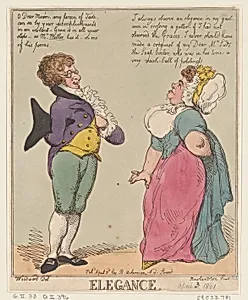
Medium
Hand-colored etching
Dimensions
Sheet: 8 15/16 × 7 3/16 in. (22.7 × 18.3 cm)
Classification
Prints
Department
Drawings and Prints
Museum
Metropolitan Museum of Art, New York, NY
Credit
The Elisha Whittelsey Collection, The Elisha Whittelsey Fund, 1959
Accession Number
59.533.781
Rights
Public Domain
Tags
Art Historical Context
Thomas Rowlandson's *Elegance*, a hand-colored etching dated April , 1801, captures the satirical spirit of early 19th-century British. Rowlandson, a master caricaturist of the Regency era, was renowned for his witty, often risqué depictions of everyday life, fashion, and social follies. This print, measuring 8 15/16 × 7 3/16 inches, exemplifies his hand-colored etching technique—a labor-intensive process where intricate lines were etched into a copper plate, printed, and then meticulously colored by hand to add vivid life and exaggerated flair. Produced during the reign of George III, amid the opulent yet hypocritical world of Regency manners, *Elegance* likely pokes fun at the era's obsession with refined appearances among men and women. Rowlandson's bold lines and humorous exaggerations highlight the absurdities of high society, making his works both entertaining commentary and sharp social critique. Hand-coloring was key to his commercial success, transforming stark black-and-white prints into colorful spectacles sold at London print shops. Housed in the Metropolitan Museum of Art's Drawings and Prints department as part of The Elisha Whittelsey Collection, this piece invites visitors to chuckle at timeless human vanity while appreciating Rowlandson's enduring influence on caricature art.
About the Artist
Thomas Rowlandson · 1756–1827
Thomas Rowlandson (1757–1827) was an English artist and caricaturist whose satirical watercolors and prints captured the social life of Georgian Britain with unparalleled wit and technical mastery. Alongside James Gillray, he is recognized as one of the greatest British graphic artists, and his distinctive flowing line and keen observations have made his work integral to understanding late 18th an...