
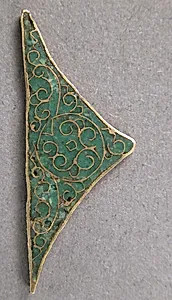
Element of an Icon Frame
Unknown Artist
11th century
Medium
Cloisonné enamel, gold, copper
Dimensions
Overall: 3/8 x 1 1/16 x 1/16 in. (1 x 2.7 x 0.2 cm)
Classification
Enamels-Cloisonné
Culture
Byzantine
Department
Medieval Art
Museum
Metropolitan Museum of Art, New York, NY
Credit
Gift of J. Pierpont Morgan, 1917
Accession Number
17.190.650
Rights
Public Domain
Art Historical Context
This delicate *Element of an Icon Frame crafted in the 11th century during the height of the Byzantine Empire, a glimpse into the opulent world of medieval religious art. Measuring just 3/8 x 1 1/16 x 1/16 inches, this tiny fragment once adorned the border of a sacred icon—a painted image of Christ, the Virgin Mary, or a saint venerated in Orthodox Christianity. Produced in Constantinople or a related workshop, it exemplifies Byzantine mastery in creating luxurious objects for churches and monasteries, where such frames elevated holy images to divine splendor. The artwork's medium—cloisonné enamel on gold and copper—highlights a sophisticated technique perfected by Byzantine artisans. Thin gold wires were soldered to form compartmentalized cells (cloisons), which were filled with finely ground glass enamels in vibrant colors, then fired at high temperatures to create a durable, gem-like sheen. This method allowed for intricate designs and jewel-toned hues that mimicked precious stones, making enamels prized for their portability and resistance to wear compared to frescoes or paintings. Housed in the Metropolitan Museum of Art's Medieval Art department since J. Pierpont Morgan's 1917 gift, this fragment underscores the enduring cultural importance of Byzantine enamels. They bridged East and West, influencing later European metalwork, and symbolized the empire's theological devotion and technical innovation. Visitors are often captivated by how such a minuscule piece once framed eternity itself.