
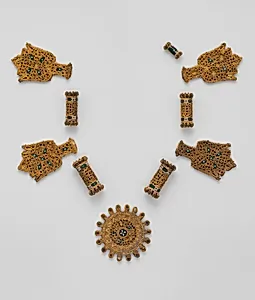
Elements from a Necklace
Unknown Artist
late 15th–16th century
Medium
Gold, cloisonnè enamel
Dimensions
f:wheel shaped medallion: 3 x 3/16 in. (7.6 x 0.5 cm) b,d,j,h:4 lotus bud plaques: 3 5/16 x 2 1/16 x 3/16 in. (8.4 x 5.2 x 0.5 cm) e,g:largest cylindrical beads: 2 x 3/4 in. (5.1 x 1.9 cm) c,i:cylindrical beads: 1 7/8 x 11/16 in. (4.8 x 1.7 cm) a:smallest cylindrical bead: 1 x 1/2 in. (2.5 x 1.3 cm)
Classification
Metalwork-Gold
Culture
Spanish
Department
Medieval Art
Museum
Metropolitan Museum of Art, New York, NY
Credit
Gift of J. Pierpont Morgan, 1917
Accession Number
17.190.161a-j
Rights
Public Domain
Art Historical Context
"Elements from a Necklace," crafted by an unknown Spanish artist in the late 15th 16th century, the exquisite metalwork of late medieval Iberia. This delicate ensemble includes a wheel-shaped medallion (just 3 inches across), four lotus bud plaques, and a series of cylindrical gold beads ranging from tiny 1-inch pieces to larger 2-inch ones. Likely part of a luxurious necklace worn by nobility, these fragments highlight the era's blend of opulence and intricate design, when Spain's Reconquista and early Renaissance fostered rich artistic exchanges. The medium—gold with cloisonné enamel—is particularly noteworthy. Artisans soldered thin gold wires into cells (cloisons) on the surface, filling them with powdered glass enamels in vibrant colors, then firing the piece to fuse them permanently. This technique, perfected in medieval Europe and the Islamic world, allowed for durable, jewel-like effects that mimicked gemstones while showcasing technical mastery. The lotus bud motifs on the plaques evoke natural elegance, possibly nodding to decorative traditions from Moorish Spain. Gifted to the Metropolitan Museum of Art by J. Pierpont Morgan in 1917, these elements preserve a glimpse of Renaissance-era splendor. Their petite scale underscores the wearer's status—such jewelry was both adornment and statement of wealth in a time of cultural flourishing.