
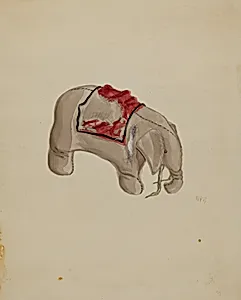
Elephant
c. 1936
Medium
watercolor, graphite, and gouache on paper
Dimensions
overall: 28.8 x 23 cm (11 5/16 x 9 1/16 in.) Original IAD Object: 14" long; 4" high
Classification
Index of American Design
Department
CG-W
Museum
National Gallery of Art, Washington, D.C.
Credit
Index of American Design
Accession Number
1943.8.15707
Rights
Public Domain
Art Historical Context
In the whimsical *Elephant* (c. 1936), artist Raoul Du Bois brings to life a delightful piece of American folk art through watercolor, graphite, and gou on paper. Measuring just 28.8 x 23 cm, this precise rendering captures a small carved wooden elephant—originally 14 inches long and 4 inches high—from the National Gallery of Art's Index American Design collection. Du Bois's skilled hand renders the creature's sturdy form, curved trunk, and playful posture with vibrant colors and fine graphite details, evoking the charm of everyday craftsmanship from America's past. Created as part of the Federal Art Project under the Works Progress Administration (WPA) during the Great Depression, the Index of American Design commissioned artists like Du Bois to document the nation's rich folk art heritage. From 1935 to 1942, over 15,000 watercolor renderings preserved objects like toys, whirligigs, and carvings that reflected regional traditions and self-taught artistry. This elephant likely represents a vernacular wooden sculpture, highlighting the ingenuity of anonymous makers who turned simple materials into enduring symbols of joy. Du Bois's mixed-media technique—gouache for bold opacity, watercolor for subtle washes, and graphite for sharp outlines—ensures both artistic beauty and documentary accuracy. Today, it invites us to appreciate how such humble designs wove whimsy into American culture, safeguarding stories of creativity amid hardship.