
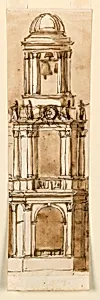
Elevation of a bell tower
1746-1809
Classification
architecture
Department
Smithsonian Collection
Museum
Smithsonian American Art Museum
Credit
Museum purchase through gift of various donors and from Eleanor G. Hewitt Fund
Accession Number
1938-88-1243
Rights
Public Domain
About this artwork
Research in Progress
Art Historical Context
Giuseppe Barberi, a prominent Italian architect active during the late 18th century (1746–1809), created this *Elevation of a Bell Tower* as a precise architectural drawing. Born in Rome, Barberi was renowned for his neoclassical designs, blending classical Roman elements with emerging Enlightenment ideals of symmetry and proportion. This work, part of the Smithsonian American Art Museum's collection, exemplifies the meticulous planning drawings essential to grand ecclesiastical architecture, where bell towers served as both functional landmarks and symbols of community faith. An "elevation" in architecture refers to a two-dimensional rendering of a building's facade, allowing builders and patrons to visualize scale, ornamentation, and structure before construction. Though the medium remains unidentified amid ongoing research, such drawings were typically executed in ink, wash, or gouache on paper, highlighting Barberi's skill in capturing light, shadow, and rhythmic verticality—hallmarks of Italian Baroque-to-Neoclassical transitions. Acquired through museum purchase with gifts from various donors and the Eleanor G. Hewitt Fund, this piece underscores the Smithsonian's commitment to preserving European architectural heritage within an American context. It invites visitors to appreciate how Barberi's vision might have shaped Italy's skyline, evoking the timeless chime of bells over historic piazzas. (198 words)