
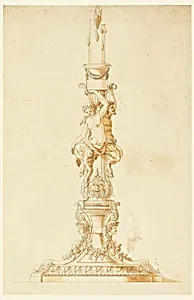
Elevation of a Candlestick
Classification
lighting
Department
Smithsonian Collection
Museum
Smithsonian American Art Museum
Credit
Purchased for the Museum by the Advisory Council
Accession Number
1911-28-69
Rights
Public Domain
About this artwork
Research in Progress
Art Historical Context
**Elevation of a Candlestick** *Jean-Jacques-François Le Barbier (French, 1738–1826), ca. 1790* Jean-Jacques-François Le Barbier a prominent French painter and draughtsman of the late Enlightenment, created this *Elevation of a Candlestick around 1790, on the eve of the French Revolution. Le Barbier was known for his neoclassical history paintings and intricate designs, blending classical motifs with the refined elegance of Louis XVI-era aesthetics. An "elevation" refers to a precise technical drawing showing the front view of an object, likely intended as a blueprint for a decorative candlestick—a essential element of grand interiors where candlelight symbolized luxury and sophistication. This work captures the neoclassical revival of ancient Greek and Roman forms, evident in the balanced proportions and ornate details typical of period lighting designs. Candlesticks like this would have illuminated salons and palaces, reflecting France's cultural shift toward rationalism and symmetry amid political upheaval. Though the medium remains unidentified amid ongoing research, its presence in the Smithsonian American Art Museum's collection—purchased by the Advisory Council—highlights cross-Atlantic appreciation for European design mastery. As a study in functional beauty, it invites us to ponder how everyday objects embodied artistic ideals, bridging utility and opulence in revolutionary times. (198 words)