
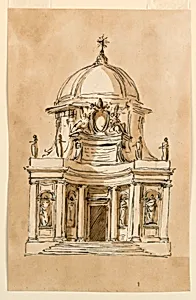
Elevation of a church
1746-1809
Medium
architecture
Classification
architecture
Department
Smithsonian Collection
Museum
Smithsonian American Art Museum
Credit
Museum purchase through gift of various donors and from Eleanor G. Hewitt Fund
Accession Number
1938-88-1210
Rights
Public Domain
About this artwork
Research in Progress
Art Historical Context
Giuseppe Barberi (1746–1809), a prominent Italian architect, created *Elevation of a Church* during his active career in 18th-century Rome. amid the shift from opulent Baroque styles to the refined lines of Neoclassicism, Barberi specialized in church designs, restorations, and intricate architectural engravings. This work, housed in the Smithsonian American Art's architecture collection, exemplifies his expertise in conceptualizing sacred spaces through precise technical drawings. An "elevation" in architecture refers to a scaled, two-dimensional representation of a building's exterior facade or side view, essential for planning and visualization before construction. Barberi's rendering likely captures the harmonious proportions and decorative elements typical of Italian ecclesiastical architecture, blending functionality with aesthetic grandeur. Acquired through museum purchase and the Eleanor G. Hewitt Fund, it highlights the enduring influence of European design traditions in American collections. Though research into this piece is ongoing, it offers visitors a window into the meticulous craft of 18th-century architectural drafting, inviting reflection on how such plans brought grand visions to life in stone and marble.