
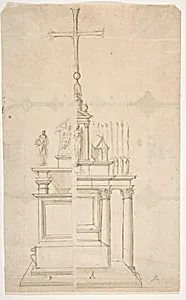
Elevation of a Main Altar with an Alternate Design
16th century
Medium
Graphite, pen and brown ink, brush and brown wash
Dimensions
sheet: 10 15/16 x 6 5/8 in. (27.8 x 16.9 cm)
Classification
Drawings
Department
Drawings and Prints
Museum
Metropolitan Museum of Art, New York, NY
Credit
The Elisha Whittelsey Collection, The Elisha Whittelsey Fund, 1949
Accession Number
49.19.115a
Rights
Public Domain
Tags
Art Historical Context
This delicate 16th-century drawing created anonymously by a French artist, presents an *Elevation of a Main Altar with an Alternate Design*. Rendered on a modest sheet measuring 10 15/16 x 6 5/8 inches, it showcases two proposed elevations for a grand church altar, adorned with columns, a prominent cross, and architectural flourishes typical of ecclesiastical spaces. Housed in the Metropolitan Museum Art's Drawings and Prints Department as part of The Elisha Whittelsey Collection, work exemplifies the meticulous preparatory sketches used by architects and designers during the French Renaissance. Crafted with graphite for preliminary outlines, pen and brown ink for precise lines, and brush with brown wash for subtle shading and depth, the drawing highlights innovative mixed-media techniques of the era. These methods allowed artists to convey three-dimensional form and spatial drama on a flat surface, aiding patrons—likely clergy or nobility—in visualizing costly church commissions amid the Catholic Church's push for ornate worship spaces during the Counter-Reformation. Such anonymous designs offer a rare glimpse into the collaborative world of 16th-century sacred architecture, where altars served as focal points for devotion. The inclusion of an alternate scheme underscores the iterative creative process, blending Gothic traditions with emerging Renaissance symmetry, making this artifact a treasure for understanding France's rich liturgical heritage.