
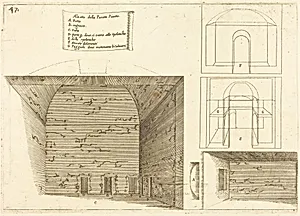
Elevation of a Passage Plan
1619
Medium
etching and engraving on laid paper [restrike]
Dimensions
sheet: 71 × 46.5 cm (27 15/16 × 18 5/16 in.)
Classification
Department
CG-E
Museum
National Gallery of Art, Washington, D.C.
Credit
Transferred from The Library of Congress
Accession Number
1986.50.191
Rights
Public Domain
Art Historical Context
Jacques Callot's *Elevation of a Passage Plan (1619) is a masterful print showcasing the French artist's innovative prowess in etching and engraving. Created during Callot's time in Florence under Medici patronage, this work exemplifies his Baroque style, renowned for intricate line work and dramatic spatial illusions. The etching—where acid etches fine lines into a metal plate—combined with engraving's precise burin cuts, allowed Callot to achieve extraordinary detail on laid paper, a period staple valued for its texture and absorbency. This restrike preserves the original's fidelity, measuring an impressive 71 × 46.5 cm. The title reveals an architectural "elevation," a flat, frontal view of a passageway design, likely part of Callot's explorations in theatrical scenery or fantastical architecture. In 1619, amid Europe's Baroque fervor, such prints bridged art and engineering, influencing stage designers and architects. Callot's ability to convey depth and grandeur in a single plane highlights printmaking's rising status as an accessible medium for disseminating grand visions. Housed in the National Gallery of Art's print collection (transferred from the Library of Congress), this piece underscores Callot's legacy as a pioneer whose techniques advanced reproductive art, captivating collectors and scholars with its technical brilliance and imaginative scope.
About the Artist
Jacques Callot · 1592–1635
Jacques Callot (1592–1635) was a French printmaker and draftsman from the Duchy of Lorraine, widely regarded as one of the first great artists to practice the graphic arts exclusively. His more than 1,400 etchings chronicled the breadth of 17th-century life, from Medici court festivities to the brutal realities of warfare. Callot revolutionized etching through technical innovations including the é...