
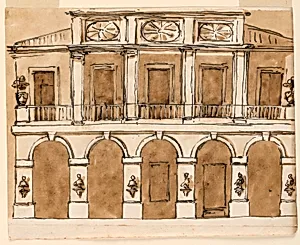
Elevation of a villa
1746-1809
Classification
architecture
Department
Smithsonian Collection
Museum
Smithsonian American Art Museum
Credit
Museum purchase through gift of various donors and from Eleanor G. Hewitt Fund
Accession Number
1938-88-1215
Rights
Public Domain
About this artwork
Research in Progress
Art Historical Context
**Elevation of a Villa** by Giuseppe Barberi (1746–1809) offers a captivating glimpse into 18th-century Italian architecture. As an Italian architect active in Rome during the Neoclassical era, Barberi specialized in elegant designs that revived classical symmetry and proportion, blending ancient Roman grandeur with Enlightenment ideals of harmony and restraint. This *elevation*—a precise frontal rendering of a villa's facade—served as a vital tool for architects, builders, and patrons to envision and refine structures before construction began. Though the medium remains unidentified amid ongoing research, such drawings were typically executed with ink, pencil, or watercolor washes on paper, emphasizing clean lines and balanced compositions. Barberi's work reflects the era's fascination with idealized country estates, symbols of refined living for the aristocracy amid Italy's vibrant architectural revival. Housed in the Smithsonian American Art Museum through a generous purchase supported by various donors and the Eleanor G. Hewitt Fund, this piece bridges European design traditions with American collections. It invites us to appreciate how architectural ideas traveled across oceans, inspiring generations—even as scholars continue to uncover its full story.