
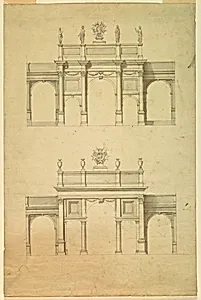
Elevations for Two Triumphal Arches in Honor of the Emperor Napoleon
Classification
architecture
Department
Smithsonian Collection
Museum
Smithsonian American Art Museum
Credit
Museum purchase through gift of various donors
Accession Number
1901-39-233
Rights
Public Domain
About this artwork
Research in Progress
Art Historical Context
Luigi Cagnola, a leading Italian neoclassical architect (1762–1833), created these *Elevations for Two Triumphal Arches in of the Emperor Napoleon* 1810. As architectural drawings classified within the Smithsonian American Art Museum's collection, they showcase precise elevation views—side profiles—of grand monumental structures designed to celebrate Napoleon's imperial triumphs. Cagnola's work reflects the era's fascination with ancient Roman architecture, revived in neoclassicism to symbolize power and eternity. During Napoleon's dominance over Europe, including much of Italy, triumphal arches became potent symbols of victory and legitimacy, echoing Rome's arches for emperors like Constantine. These designs likely envisioned similar honors for the French leader, blending Italian heritage with Napoleonic ambition. Cagnola, known for his rational yet majestic style, contributed to Milan's urban grandeur, making these elevations a window into early 19th-century architectural patronage. Though the medium remains under study, such drawings were vital tools for commissions, allowing patrons to visualize projects before construction. Acquired through museum donors, they highlight Napoleon's cultural footprint in art and architecture, inviting us to ponder how empires commissioned stone to immortalize fleeting glory.