
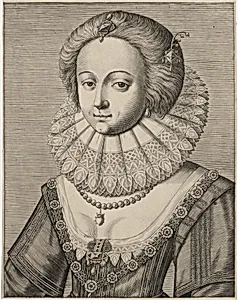
Elizabeth, Queen of Bohemia (?)
Unknown Artist
1776 to 1800
Medium
engraving
Dimensions
sheet: 21.5 × 17 cm (8 7/16 × 6 11/16 in.)
Classification
Department
CG-E
Museum
National Gallery of Art, Washington, D.C.
Credit
Rosenwald Collection
Accession Number
1951.11.964
Rights
Public Domain
Art Historical Context
This delicate engraving, tentatively titled *Elizabeth, Queen of Bohemia captures the poised likeness of a storied 17th-century royal, created by an unknown artist between 1776 and 1800. Measuring a modest 21.5 × 17 cm, it hails from the National Gallery of Art'swald Collection in the Prints department. The question mark in the title reflects scholarly caution about the portrait's exact identification, but it evokes Elizabeth Stuart (1596–1662), the eldest daughter of King James I England. Dubbed the "Winter Queen" for her fleeting reign alongside husband Frederick V, Elector Palatine, during the 1619 Bohemian uprising that ignited the Thirty Years' War, she became a symbol of Protestant resistance and Stuart exile. As an engraving—a precise intaglio technique where lines are incised into a metal plate, inked, and pressed onto paper—this print exemplifies late Enlightenment-era reproduction methods. Such works democratized access to historical portraits, allowing collectors to own affordable echoes of aristocratic grandeur long after the subject's time. Produced over a century after Elizabeth's death, it reflects renewed 18th-century fascination with Stuart history amid political upheavals like the American and French Revolutions. Though the artist's identity remains elusive, the engraving's fine lines and period frame invite us to ponder Elizabeth's enduring legacy: a queen whose brief crown inspired poetry, drama, and loyalty across Europe. A charming window into how prints preserved royal memory for everyday admirers.