
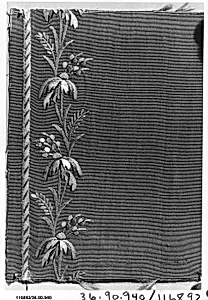
Embroidery sample for a man’s suit or waistcoat
Unknown Artist
ca. 1785–1820
Medium
Silk embroidery on silk
Dimensions
L. 4 x W. 3 inches 10.2 x 7.6 cm
Classification
Textiles-Embroidered
Culture
French
Department
European Sculpture and Decorative Arts
Museum
Metropolitan Museum of Art, New York, NY
Credit
Gift of The United Piece Dye Works, 1936
Accession Number
36.90.940
Rights
Public Domain
Art Historical Context
This delicate embroidery sample, created in France around 1785–1820, was designed as a pattern for adorning a gentleman’s suit or waistcoat Measuring just 4 by 3 inches, it the exquisite textile craftsmanship of the late Enlightenment and Revolutionary eras, when French fashion set global standards for elegance and refinement. Such samples practical purposes for tailors clients, allowing them to intricate designs before committing to full garments. Silk embroidery on silk taffeta highlights the technical mastery of anonymous needleworkers, who employed fine threads to create luminous patterns that caught the light. During this period, men’s formal wear often featured elaborate floral or geometric motifs, symbolizing status and sophistication amid shifting styles from Rococo exuberance to Neoclassical restraint. As political upheavals like the French Revolution prompted simpler attire, these luxurious embroideries became cherished relics of pre-Revolutionary opulence. Housed in The Metropolitan Museum of Art’s European Sculpture and Decorative Arts Department, this piece—gifted in 1936 by The United Piece Dye Works—offers a tactile glimpse into 18th-century sartorial culture, reminding us how textiles wove artistry into everyday luxury.