
Emily, Countess of Kildare
1754
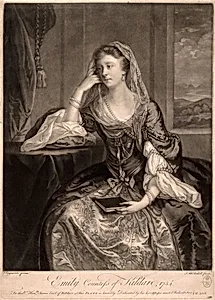
Medium
Mezzotint in black on cream laid paper
Dimensions
Image: 31.5 × 24.8 cm (12 7/16 × 9 13/16 in.); Plate: 35 × 25 cm (13 13/16 × 9 7/8 in.); Sheet: 35.6 × 25.6 cm (14 1/16 × 10 1/8 in.)
Classification
mezzotint
Department
Prints and Drawings
Museum
Art Institute of Chicago
Accession Number
46428
Rights
Public Domain
Art Historical Context
This striking mezzotint portrait captures Emily, Countess of Kildare, a prominent figure in 18th-century Irish aristocracy. Created by James McArdell in 1754, the work exemplifies the era’s growing fascination with reproductive prints, which allowed aristocratic likenesses to reach wider audiences beyond the original painted canvas. McArdell, an Irish engraver renowned for his skill in mezzotint, specialized in translating the subtle gradations of oil portraits into rich, velvety prints that preserved both status and personality. The medium itself is central to the artwork’s appeal. Mezzotint, worked from a roughened copper plate, produces deep blacks and delicate tonal transitions ideally suited to rendering luxurious fabrics, powdered hair, and expressive faces. Printed in black ink on cream laid paper, this impression demonstrates the technique’s capacity for dramatic contrast and intimate detail, qualities that made such prints highly collectible among the period’s educated elite. Today housed in the Art Institute of Chicago’s Department of Prints and Drawings, the sheet offers visitors a window into Georgian society’s visual culture, where art, fashion, and social rank converged through the reproducible power of mezzotint.
About the Artist
James McArdell · 1729–1765
**James MacArdell** (c. 1729 – 2 June 1765) was an Irish mezzotint engraver renowned for his masterful portraits of prominent figures in 18th-century Britain and Ireland. Born in Cow Lane (later Greek Street) in Dublin’s St Michan’s Parish, he trained under the engraver John Brooks. When Brooks relocated to London in 1746, MacArdell followed along with fellow pupils including Charles Spooner, esta...