
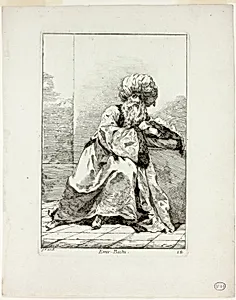
Emir Bachi, plate twelve from Caravanne du Sultan à la Mecque
Medium
Etching on ivory laid paper
Dimensions
Image: 19.5 × 13.1 cm (7 11/16 × 5 3/16 in.); Plate: 20.3 × 13.5 cm (8 × 5 3/8 in.); Sheet: 26.5 × 21.1 cm (10 7/16 × 8 5/16 in.)
Classification
etching
Department
Prints and Drawings
Museum
Art Institute of Chicago
Accession Number
207704
Rights
Public Domain
Art Historical Context
Step into the exotic world of 18th-century European imagination with *Emir Bachi*, twelve from Joseph Marie Vien's *Caravanne du Sultan à la Mecque*, in 1748. This etching captures a dignified figure—likely an emir or high-ranking attendant—in the grand procession of a sultan's pilgrimage to Mecca. Vien, a French artist bridging Rococo elegance and emerging Neoclassicism, from the era's fascination with Oriental tales, blending real travel accounts with romanticized visions of Islamic culture during the Enlightenment. As part of a rare series of etchings, this print reflects the growing European curiosity about the Middle East, fueled by trade routes and diplomatic exchanges. Vien's work helped popularize "Orientalism" in art, portraying the opulent caravan as a symbol of mystery and splendor long before later 19th-century exponents like Delacroix. Crafted as an etching on fine ivory laid paper (image 19.5 × 13.1 cm), the technique allowed Vien to achieve intricate, fluid lines with tonal depth through acid-etched copper plates. This intimate scale made it ideal for collectors' albums, preserving vivid details of turbans, robes, and desert vistas for 18th-century audiences hungry for the exotic. Housed in the Art Institute of Chicago's Prints and Drawings department, it invites us to ponder how art bridged distant worlds.
About the Artist
Joseph Marie Vien, I · 1716–1809
Joseph-Marie Vien (1716–1809) was born in Montpellier and trained in Paris under Charles-Joseph Natoire. A brilliant student, he won the Prix de Rome in 1743 and spent the years 1744 to 1750 at the French Academy in Rome, where his encounter with the antiquarian scholarship of the Comte de Caylus and the early stirrings of neoclassical taste around the discoveries at Herculaneum and Pompeii proved...