
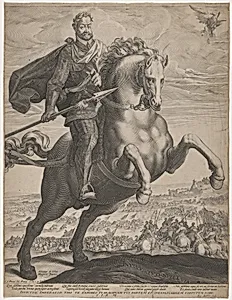
Emperor Rudolph II on Rearing Horse
1551 to 1600
Medium
engraving
Dimensions
sheet: 50.5 × 38.8 cm (19 7/8 × 15 1/4 in.)
Classification
Department
CG-E
Museum
National Gallery of Art, Washington, D.C.
Credit
Rosenwald Collection
Accession Number
1950.14.1051
Rights
Public Domain
Art Historical Context
Behold *Emperor Rudolph II onearing Horse*, a striking engraving by Flemish artist Aegidius Sadeler II, after a sculpture by Dutch master Adriaen de Vries Dating to between 1551 and1600, this large-scale print (50.5 × 38.8 cm) captures the Roman Emperor Rudolph II in dynamic equestrian pose, rearing triumphantly atop a powerful steed. Housed in the National Gallery of Art's Rosenwald Collection, it exemplifies the reproductive print tradition, where Sadeler's precise engraving skills immortalized de Vries's sculptural design for wider audiences. In the late 16th century, Rudolph II's Prague court was a glittering hub of Mannerism, blending intricate detail with dramatic flair. As a lavish patron of the arts, the emperor commissioned works like de Vries's bronzes to project imperial power and intellectual prestige. Sadeler, who worked in Rudolph's circle, translated the sculpture's three-dimensional energy into two dimensions through fine-line engraving—a meticulous intaglio technique involving incised metal plates inked and pressed onto paper. This medium democratized elite art, allowing prints to circulate across Europe. This artwork not only glorifies Rudolph's reign but also highlights the collaborative brilliance of Northern European artists during the Renaissance's twilight. Visitors, imagine the emperor's gaze meeting yours amid the horse's coiled muscles—a testament to artistry that bridged sculpture and print, emperor and everyman.