
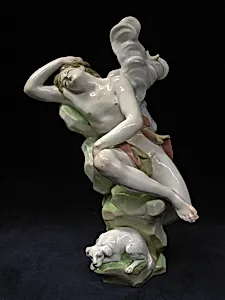
Endymion
ca. 1760–70
Medium
Soft-paste porcelain
Dimensions
Height: 9 1/2 in. (24.1 cm)
Classification
Ceramics-Porcelain
Culture
Spanish, Madrid (Buen Retiro)
Department
European Sculpture and Decorative Arts
Museum
Metropolitan Museum of Art, New York, NY
Credit
The Hans Syz Collection, Gift of Stephan B. Syz and John D. Syz, 1995
Accession Number
1995.268.347
Rights
Public Domain
Tags
Art Historical Context
In the European Sculpture and Decorative Arts, the delicate porcelain figure *Endymion* (ca. 1760–70) from Spain's Real Fabrica deen Retiro captures a serene mythological moment. Crafted in soft-paste porcelain, 9½-inch (24.1 cm) sculpture depicts the shepherd Endymion in eternal slumber, accompanied by his loyal dogs—a nod to the Greek myth where the moon goddess Selene falls in love with him and grants him everlasting youth through sleep. The intimate scale and graceful modeling evoke the Rococo taste for elegant, narrative vignettes. Produced at the royal Buen Retiro factory in Madrid, established around 1760 under King Charles III, this piece reflects Spain's ambitious entry into Europe's porcelain race. Soft-paste porcelain, made with ground bone ash and fired at lower temperatures, allowed for finer detailing than earlier ceramics but was more fragile than German hard-paste. Buen Retiro's output, often mythological or genre scenes, drew inspiration from Sèvres and Meissen, showcasing technical prowess in painting, gilding, and naturalistic animal figures. As part of The Hans Syz Collection at The Metropolitan Museum of Art, *Endymion* highlights the cultural prestige of porcelain in 18th-century courts, blending artistry with luxury. Its whimsical charm invites visitors to ponder timeless tales of love and dreams preserved in fragile splendor.