
English Horn
ca. 1860–70
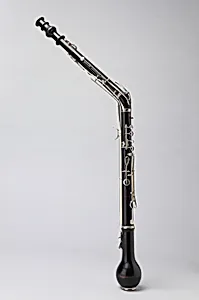
Medium
Nickel-silver, boxwood
Dimensions
L. 78.6 cm (30-15/16 in.)
Classification
Aerophone-Reed Vibrated-double reed
Culture
Austrian
Department
Musical Instruments
Museum
Metropolitan Museum of Art, New York, NY
Credit
Purchase, Clara Mertens Bequest, in memory of André Mertens, 1998
Accession Number
1998.419
Rights
Public Domain
Art Historical Context
This English horn, crafted around 1860–70 by Austrian maker Johann Tobias Uhlmann, represents the refined woodwind traditions of mid-nineteenth-century Vienna. As a double-reed aerophone, it belongs to the oboe family and produces a warm, mellow tone suited to orchestral and chamber music of the Romantic era. Uhlmann’s workshop was renowned for precise construction, and this example showcases the transition from earlier straight-bodied designs to the curved form that became standard. The instrument’s body is fashioned from boxwood, valued for its resonant qualities and fine grain, while nickel-silver fittings provide durability and smooth key action. At just under 79 centimeters in length, its compact size belies the technical sophistication required to balance intonation across its range. Such instruments were essential in expanding the expressive palette of orchestras, allowing composers to evoke pastoral or melancholic moods. Acquired by the Metropolitan Museum through the Clara Mertens Bequest, this horn offers visitors a tangible link to the golden age of Viennese instrument making and the evolving soundscape of European classical music.