
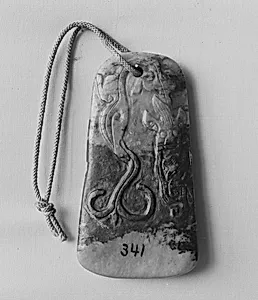
Engraved Celt
Unknown Artist
Medium
Nephrite, pale green with broad band of brown and black staining.
Dimensions
H. 2 7/8 in. (7.3 cm); W. 1 5/8 in. (4.1 cm); L. 1/4 in. (0.6 cm)
Classification
Jade
Culture
China
Department
Asian Art
Museum
Metropolitan Museum of Art, New York, NY
Credit
Gift of Heber R. Bishop, 1902
Accession Number
02.18.341
Rights
Public Domain
Art Historical Context
This exquisite Engraved Celt, crafted from pale green nephrite jade with striking bands of brown and black, exemplifies the ancient Chinese mastery of hardstone carving. Measuring just 2⅞ inches high, 1⅝ inches wide, and inch thick, its compact form suggests it was a handheld ceremonial object, likely from China's Neolithic or early Bronze Age periods.rite, tougher than its cousin jadeite, was prized for its durability and symbolic purity, often used for ritual tools like celts—axe-like implements that transcended practical use to embody spiritual power and elite status. The intricate engravings on this celt highlight sophisticated techniques, where artisans meticulously incised patterns into the unyielding jade using fine abrasives and bow-drills. In ancient Chinese culture, such jade artifacts were buried with the elite, serving as grave goods to connect the living with ancestors and the cosmos. This piece, a gift to the Metropolitan Museum of Art from Heber R. Bishop in 1902, offers a window into the reverence for jade as a "stone of heaven," bridging artistry and cosmology in early civilizations.