
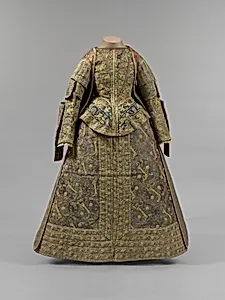
Ensemble
Unknown Artist
late 16th century
Medium
silk, linen
Classification
Ensemble
Culture
Spanish
Department
Costume Institute
Museum
Metropolitan Museum of Art, New York, NY
Credit
Fletcher Fund, 1925
Accession Number
25.118a–c
Rights
Public Domain
Art Historical Context
This exquisite *Ensemble* from late 16th-century Spain, crafted from luxurious silk and linen, offers a rare glimpse into the opulent world of Renaissance-era fashion. Housed in the Metropolitan Museum Art's Costume Institute and acquired through the Fletcher Fund in 1925, it exemplifies the elaborate attire worn by Spanish nobility during the of the Spanish Golden Age. The combination of shimmering silk—prized for its sheen and imported at great expense—with sturdy linen highlights the era's masterful textile work, where fine weaving and dyeing techniques showcased wealth and status. In the late 1500s, under monarchs like Philip II and III, Spanish clothing emphasized rigid silhouettes, such as farthingales and ruffs, influenced by courtly etiquette and the Catholic Church's somber aesthetics. Black silks, often favored in Spain, symbolized piety and power amid the empire's global reach. This ensemble, attributed to an unknown artist, reflects these cultural hallmarks, blending practicality with grandeur in a culture that set trends across Europe. Today, it stands as a tangible link to daily life in Habsburg Spain, inviting us to imagine the wearer's world—from royal balls to religious processions. A testament to preservation, it underscores the Costume Institute's role in illuminating fashion's historical narrative.