
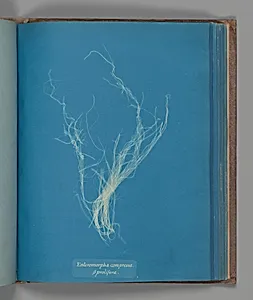
Enteromorphia compressa, ß prolifera
ca. 1853
Medium
Cyanotype
Dimensions
Image: 25.3 x 20 cm (9 15/16 x 7 7/8 in.)
Classification
Photographs
Department
Photographs
Museum
Metropolitan Museum of Art, New York, NY
Credit
Gilman Collection, Purchase, The Horace W. Goldsmith Foundation Gift, through Joyce and Robert Menschel, 2005
Accession Number
2005.100.557 (110)
Rights
Public Domain
Art Historical Context
**Enteromorphia compressa, ß prolifera** *Anna Atkins, ca. 1853* Cyanotype; Image: 25.3 x 20 cm Step into the pioneering world of Anna Atkins, a British botanist and photographer whose innovative work bridged science and art in the mid-19th century. This delicate cyanotype captures the intricate form of *Enteromorphia compressa*, a type of green seaweed, rendered in Atkins' signature Prussian blue tones. Created around 1853, it exemplifies her groundbreaking *Photographs of British Algae: Cyanotype Impressions* (1843–53), the first book ever illustrated entirely with photographs. Atkins mastered the cyanotype process, invented by Sir John Herschel in 1842, by placing seaweed specimens directly on light-sensitive paper coated with ferric ammonium citrate and potassium ferricyanide. Exposed to sunlight and then washed, the result was a precise "photogram"—a camera-less image that preserved the algae's natural textures and fronds with stunning fidelity. This technique revolutionized botanical illustration, offering unprecedented accuracy over hand-drawn sketches. Housed in The Metropolitan Museum of Art's Gilman Collection, this print highlights Atkins' dual legacy as a scientist and artist. Amid the dawn of photography, her work not only advanced scientific documentation but also elevated the medium as fine art, inviting viewers to marvel at nature's hidden elegance through a Victorian lens.
About the Artist
Anna Atkins · 1799–1871
Anna Atkins (née Children), born on March 16, 1799, in Tonbridge, Kent, England, grew up immersed in the world of science thanks to her father, John George Children, a prominent chemist, zoologist, and curator at the British Museum. After her mother Hester's death shortly after childbirth in 1800, Anna formed a close bond with her father, receiving an exceptional scientific education rare for wome...