
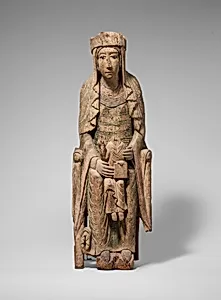
Enthroned Virgin and Child
Unknown Artist
ca. 1130–1140
Medium
Birch with paint and glass
Dimensions
40 1/2 in. × 13 in. × 11 1/4 in. (102.9 cm, 28.5 cm)
Classification
Sculpture-Wood
Culture
French
Department
The Cloisters
Museum
Metropolitan Museum of Art, New York, NY
Credit
The Cloisters Collection, 1947
Accession Number
47.101.15
Rights
Public Domain
Tags
About this artwork
This monumental Enthroned Virgin and Child represents one of the finest surviving examples of French Romanesque wood sculpture from the 12th century. Carved circa 1130-1140 from birch and originally decorated with paint and glass insets, it exemplifies the 'Throne of Wisdom' (Sedes Sapientiae) type, where Mary serves as the throne for Christ, emphasizing his divine authority and her role as Theotokos (God-bearer). The sculpture's provenance from the vicinity of Autun, Burgundy, connects it to th...
Art Historical Context
This monumental *Enthroned Virgin and Child*, around 1130–1140 from birch wood and adorned with paint and glass insets, stands as one of the finest examples of French Romanesque. Hailing from near Autun in Burgundy, it belongs to the iconic "Throne of Wisdom" (*Sedesientiae*) tradition, where the Virgin Mary serves the literal seat for the Christ Child, symbolizing her as *Theotokos*—the God-bearer—and underscoring Christ's divine authority. At over 40 inches tall, this sculpture would have dominated its original church setting, radiating spiritual power during liturgical ceremonies. The work reflects the distinctive style of the Autun workshop, linked to the Cathedral of Saint-Lazare, with its heavy-lidded eyes, meticulously patterned drapery, and a poignant depiction of a weary Mary—her slumped shoulders and accepting gaze conveying quiet endurance as she cradles the Child between her hands. One striking detail is the original blue glass eye in her proper right socket, a rare survival; the other is a modern replacement. Likely functioning as a reliquary, with a cavity at the back for holy relics (or to prevent wood splitting), it exemplifies the era's blend of devotion and craftsmanship. As one of the few Romanesque wooden sculptures from Burgundy to endure, this piece from The Cloisters captures the intense spirituality and formal elegance of 12th-century French art, inviting visitors to ponder Mary's humanity amid divine mystery.