
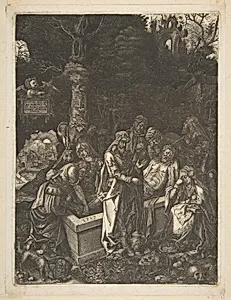
Entombment
n.d.
Medium
Engraving
Dimensions
Sheet: 9 15/16 × 7 9/16 in. (25.3 × 19.2 cm)
Classification
Prints
Department
Drawings and Prints
Museum
Metropolitan Museum of Art, New York, NY
Credit
Harris Brisbane Dick Fund, 1953
Accession Number
53.601.19(243)
Rights
Public Domain
Tags
Art Historical Context
Albrecht Dürer, masterful German artist of the Northern Renaissance (1471–1528), *Entombment*, a engraving that captures a pivotal moment from the Passion of Christ. Here, Christ's body is tenderly lowered into the tomb, surrounded by the Virgin Mary and grieving figures, their sorrow etched in every line. This undated work exemplifies Dürer's profound religious devotion and his skill in conveying deep human emotion through printmaking, evoking a profound sense of sadness that resonates with viewers across centuries. As a pioneering engraver, Dürer transformed the medium from mere reproduction to high art. Using a copper plate incised with fine burin lines, he achieved extraordinary detail—delicate folds in drapery, subtle facial expressions, and atmospheric depth—in a compact sheet measuring nearly 10 by 7.5 inches. His technique allowed for precise control over tone and texture, making engravings like this affordable and widely distributable, spreading Renaissance humanism and Christian iconography throughout Europe. Housed in the Metropolitan Museum of Art's Drawings and Prints department, acquired through the Harris Brisbane Dick Fund in 1953, *Entombment* highlights Dürer's enduring legacy. It invites visitors to ponder the universal themes of loss and piety, bridging 16th-century devotion with modern reflection.
About the Artist
Albrecht Dürer · 1471–1528
Albrecht Dürer (1471–1528) stands as the preeminent figure of the Northern Renaissance and arguably the most influential artist in the history of printmaking. Born in Nuremberg on May 21, 1471, and dying in the same city on April 6, 1528, Dürer revolutionized the status of the artist in Northern Europe, transforming printmaking from a commercial craft into an independent fine art and establishing ...