
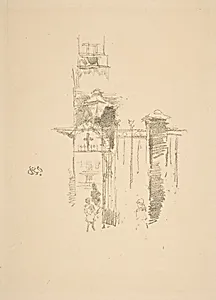
Entrance Gate
Medium
Transfer lithograph,printed in black ink on cream laid Dutch paper; only state (Chicago)
Dimensions
Image: 5 13/16 × 4 3/4 in. (14.8 × 12 cm) Sheet: 11 1/8 in. × 9 in. (28.2 × 22.9 cm)
Classification
Prints
Department
Drawings and Prints
Museum
Metropolitan Museum of Art, New York, NY
Credit
Harris Brisbane Dick Fund, 1917
Accession Number
17.3.168
Rights
Public Domain
Tags
Art Historical Context
James McNeill Whistler’s *Entrance Gate* (1887) is a delicate transfer lithograph, capturing an atmospheric scene of a wrought-iron gate framed by architecture, with subtle human figures suggesting quiet passage. Printed in black ink on cream Dutch paper, this sole state—known as the Chicago impression—measures a modest 5 13/16 × 4 3/4 inches, inviting intimate contemplation. Housed in the Metropolitan Museum of Art’s Drawings and Prints department, it exemplifies Whistler’s mastery of printmaking during his later career in London. Whistler, a leading figure in the Aesthetic Movement, championed “art for art’s sake,” prioritizing harmony of tone and subtle suggestion over narrative detail. Transfer lithography, his chosen technique here, allowed painterly fluidity: drawings on paper were transferred to lithographic stone, yielding soft, velvety lines and tonal gradations reminiscent of his famed nocturnes and etchings. The crosshatching and sparse figures evoke a dreamlike Venice or provincial European gateway, blending realism with impressionistic mood. This work highlights Whistler’s innovative print series from the 1880s, which democratized his aesthetic vision through affordable editions. Acquired via the Harris Brisbane Dick Fund in 1917, *Entrance Gate* remains a testament to his influence on modern graphic arts, where less is profoundly more.
About the Artist
James McNeill Whistler · 1834–1903
James Abbott McNeill Whistler (1834-1903) was an American-born painter and printmaker who became a leading figure in the Aesthetic Movement and pioneer of Tonalism and Japonisme. He revolutionized art by championing "art for art's sake" and treating paintings as visual equivalents of musical compositions, titling works as "arrangements," "harmonies," and "nocturnes" to emphasize formal qualities o...