
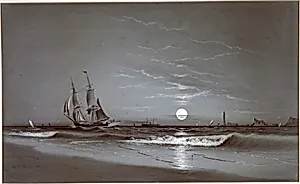
Entrance to Harbor—Moonlight
Medium
Watercolor, gouache, graphite, pastel, and sgraffito on white wove paper coated with gray gouache
Dimensions
9 1/4 x 15 in. (23.5 x 38.1 cm)
Classification
Watercolor
Culture
American
Department
The American Wing
Museum
Metropolitan Museum of Art, New York, NY
Credit
Rogers Fund, 1968
Accession Number
68.41
Rights
Public Domain
Tags
Art Historical Context
David Johnson Kennedy's *Entrance to Harbor—Moon* (1881) captures a serene nocturnal seascape, evoking the quiet drama of ships navigating into a harbor under a luminous moon. This American artwork, housed in The Metropolitan Museum of Art's American Wing, reflects the 19th-century fascination with maritime scenes, blending natural beauty with human endeavor. Painted during a period when American artists increasingly explored light and atmosphere, Kennedy's composition highlights the moon's glow illuminating waves and vessels, a nod to the Romantic tradition of seascapes that celebrated the sublime power of nature. The piece showcases an innovative mixed-media approach on white wove paper coated with gray gouache: watercolor and gouache for fluid luminosity, graphite for precise lines, pastel for soft blending, and sgraffito—a scratching technique—to reveal underlying layers and create textured highlights on water and sails. At 9¼ × 15 inches, its intimate scale invites close viewing, emphasizing delicate effects of moonlight on the sea. Acquired through the Rogers Fund in 1968, it exemplifies the technical virtuosity of American watercolorists experimenting beyond oils. Kennedy's work underscores the cultural importance of harbor imagery in Gilded Age America, symbolizing safe passage and economic vitality amid expanding trade routes. Visitors will appreciate its ethereal glow, a poetic pause amid industrial progress.