
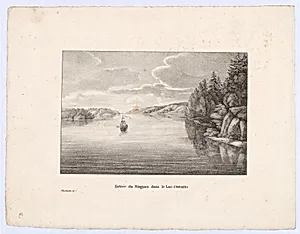
Entrée du Niagara dans le Lac Ontario
Medium
Lithograph
Dimensions
Image: 5 3/16 x 7 15/16 in. (13.2 x 20.1 cm) Sheet: 9 9/16 x 12 3/8 in. (24.3 x 31.4 cm)
Classification
Prints
Department
Drawings and Prints
Museum
Metropolitan Museum of Art, New York, NY
Credit
The Edward W. C. Arnold Collection of New York Prints, Maps and Pictures, Bequest of Edward W. C. Arnold, 1954
Accession Number
54.90.1203
Rights
Public Domain
Tags
Art Historical Context
Created in 1824, *Entrée du dans le Lac Ontario* captures the dramatic meeting point where the Niagara River flows into Lake Ontario. This lithograph, measuring just over five by eight inches in the image area, reflects the early-century fascination with North America’s natural wonders. The work is credited to Charlotte Bonaparte, niece of Napoleon, along with collaborators Michelhislain Staple and Ambroise M. Jobard, suggesting a collaborative printmaking process typical of the period. Lithography, a relatively new medium at the time, allowed artists to reproduce detailed scenes with greater speed and subtlety than earlier engraving techniques. The presence of small boats on the water emphasizes both the scale of the landscape and the human presence within it, inviting viewers to imagine travel and exploration along these waterways. The print’s French title further hints at its appeal to European audiences curious about the American continent. Today housed in the Metropolitan Museum of Art’s Department of Drawings and Prints, the work forms part of the Edward W. C. Arnold Collection. It offers a window into how early nineteenth-century artists and printmakers brought distant landscapes to a wider public, blending scientific observation with the romantic appeal of untamed nature.