
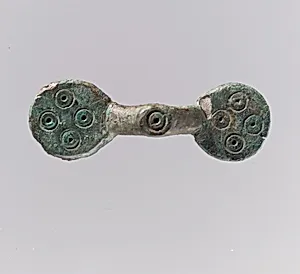
Equal-Arm Brooch
Unknown Artist
7th–8th century
Medium
Copper alloy
Dimensions
Overall: 1 1/2 x 1/2 x 3/8 in. (3.8 x 1.3 x 0.9 cm)
Classification
Metalwork-Copper alloy
Culture
Frankish
Department
Medieval Art
Museum
Metropolitan Museum of Art, New York, NY
Credit
Gift of J. Pierpont Morgan, 1917
Accession Number
17.191.219
Rights
Public Domain
Art Historical Context
This delicate Equal-Arm Brooch crafted by an unknown Frankish artisan in the 7th–8th century, exemplifies the metalworking skills of early medieval Europe. Measuring just 1 1/2 x 1/2 x 3/8 inches, its symmetrical "equal-arm" design—two mirrored arms meeting at a central pin mechanism—was ingeniously engineered to securely fasten cloaks or garments. Made from copper alloy, a durable and accessible material, it highlights the Franks' practical yet elegant approach to personal adornment during the Merian era, when such brooches served both functional and status-signaling roles among warriors, nobles, and everyday folk. In the turbulent world of post-Roman Gaul (modern France and Germany), Frankish metalwork like this brooch bridged pagan traditions and emerging Christian influences. Copper alloy was favored for its workability, allowing intricate casting and possible gilding or inlay (though not preserved here), making jewelry both affordable and prestigious. These artifacts offer rare glimpses into daily life, trade networks, and cultural exchanges across the Rhine region. A generous gift from J. Pierpont Morgan in 1917, this brooch now graces the Metropolitan Museum of Art's Medieval Art collection, inviting us to appreciate the quiet artistry of an anonymous maker whose work endured centuries.