
Equal-Arm Brooch
Unknown Artist
ca. 650–750
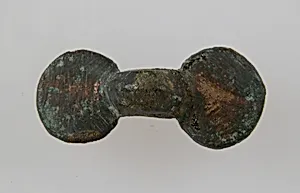
Medium
Copper alloy
Dimensions
Overall: 1 1/8 x 1/2 x 1/2 in. (2.8 x 1.2 x 1.2 cm)
Classification
Metalwork-Copper alloy
Culture
Frankish
Department
Medieval Art
Museum
Metropolitan Museum of Art, New York, NY
Credit
Gift of J. Pierpont Morgan, 1917
Accession Number
17.193.307
Rights
Public Domain
Art Historical Context
This delicate Equal-Arm Brooch crafted by an unknown Frankish artisan around 650–750 CE, exemplifies the refined metalworking of early medieval Europe. Measuring just 1 1/8 x 1/2 x 1/2 inches, its symmetrical design—two equal arms connected by a central bow with a hinged pin—made it ideal for fastening cloaks or garments, often worn in pairs on the shoulders by women of status. Housed in the Metropolitan Museum of Art's Medieval Department, it entered the collection as a gift from J. Pierpont Morgan in 7. Frankish culture, flourishing in what is now France and Germany during the Merovingian period, produced such jewelry as symbols of wealth and identity amid the transition from late antiquity to the Middle Ages. Copper alloy, a durable yet accessible material, allowed for intricate casting and assembly techniques that highlighted skilled craftsmanship without the extravagance of gold. These brooches reflect broader trade networks and artistic continuity from Roman traditions. Though modest in scale, this brooch offers a tangible glimpse into daily life and social hierarchy in the Frankish world, reminding us how personal adornments preserved cultural legacies through turbulent times.