
Medium
etching on chine collé on wove paper
Dimensions
image: 24.9 × 19.8 cm (9 13/16 × 7 13/16 in.) sheet (chine collé): 33.6 × 25.6 cm (13 1/4 × 10 1/16 in.) mount: 45.6 × 33.1 cm (17 15/16 × 13 1/16 in.)
Classification
Department
CG-E
Museum
National Gallery of Art, Washington, D.C.
Credit
Gift of Addie Burr Clark
Accession Number
1946.9.21
Rights
Public Domain
Art Historical Context
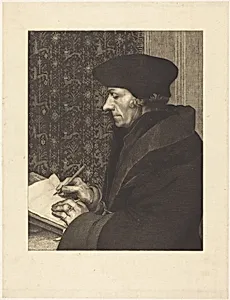
This exquisite etching, titled *Erasmus* (1863), captures the piercing gaze and scholarly demeanor of the Renaissance humanist Desiderius Erasmus as reinterpreted by French etcher Félix Bracquemond after Holbein the Younger's iconic 1523 portrait. Holbein, a master of the Northern Renaissance, for his precise, psychologically insightful portraits of Tudor England and European intellectuals, depicted Erasmus at the height of his influence as a philosopher, theologian, and critic the Church. Bracquemond's reproduction honors this legacy during the 19th-century revival of etching, a technique that allowed artists to emulate the fine lines and textures of old master drawings with remarkable fidelity. Printed on chine collé—thin Chinese paper adhered to sturdy wove support during the inking process—this medium exemplifies the technical sophistication of 19th-century printmaking. The delicate layering ensured vibrant ink transfer and durability, making high-quality reproductions accessible to collectors. Measuring nearly 10 by 8 inches in its image area, the print balances intimacy with grandeur, inviting viewers to ponder Erasmus's enduring call for intellectual freedom amid religious turmoil. A gift to the National Gallery of Art from Addie Burr Clark, this work bridges Renaissance humanism and modern connoisseurship, reminding us how prints democratized art history for generations of admirers.