
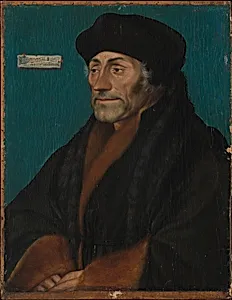
Erasmus of Rotterdam
Hans Holbein the Younger, ca. 1532
About this artwork
This intimate portrait of *Erasmus of Rotterdam* by Hans Hol the Younger, painted around 1532, captures the renowned Dutch philosopher and humanist scholar at a pivotal moment in European intellectual history. Erasmus, a leading voice of the Northern Renaissance, championed religious reform, classical learning, and tolerance amid the brewing Protestant Reformation. Holbein, a Basel-born master portraitist who later served Henry VIII's court, depicted his friend and patron with remarkable precision on a small linden wood panelmeasuring just 7¼ x 5⁹/₁₆ inches—making it ideal for private study or display. Holbein's oil technique exemplifies the Northern Renaissance's shift toward luminous realism and psychological depth. Using fine brushes on the smooth linden surface, he rendered Erasmus's thoughtful gaze, fur-trimmed robe, and subtle facial details with lifelike clarity, conveying the scholar's intellect and gravitas. Such small-scale panels were prized for their portability and intimacy, often exchanged among elites as tokens of esteem. Housed in the Metropolitan Museum of Art's Robert Lehman Collection since 1975, this work highlights Holbein's unparalleled skill in portraiture, bridging medieval traditions with emerging individualism. Visitors will appreciate how it humanizes a towering figure whose writings influenced thinkers from Luther to Montaigne.