
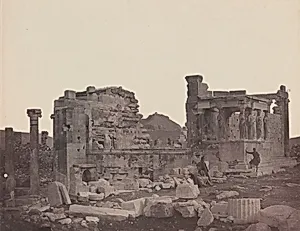
Erectheum Caryatids
1857
Medium
salted paper print
Dimensions
image: 23.1 × 29.5 cm (9 1/8 × 11 5/8 in.)
Classification
Photograph
Department
CPH
Museum
National Gallery of Art, Washington, D.C.
Credit
Gift of Michael and Jane Wilson
Accession Number
2012.137.11
Rights
Public Domain
Art Historical Context
James Robertson’s “Erectheum Caryatids” captures the graceful marble maidens that support the south porch of the Erechtheum, one of the most celebrated temples on the Athenian Acropolis. Created in 1857 as a salted-paper print, the photograph records these ancient figures at a moment when photography was still a young medium, offering viewers a tangible link to classical antiquity through the soft, luminous tones characteristic of early paper prints. Salted-paper prints like this one were among the first photographic processes capable of rendering fine architectural and sculptural detail on paper. Robertson’s image preserves the quiet strength and elegant drapery of the caryatids while also documenting their weathered surfaces and the temple’s setting. The work’s modest scale—roughly 23 by 30 centimeters—invites intimate study, allowing modern audiences to appreciate both the artistry of fifth-century BCE Greece and the nineteenth-century fascination with recording its surviving monuments. As part of the National Gallery of Art’s collection, this gift from Michael and Jane Wilson highlights photography’s vital role in shaping our visual understanding of the classical past.
About the Artist
James Robertson · 1813–1881
James Downie Robertson, known professionally as James D. Robertson (1931–2010), was a distinguished Scottish painter whose vibrant depictions of the rugged West Coast landscapes profoundly shaped modern Scottish art. Born in Cowdenbeath, Fife, as one of twin boys, his family relocated to Glasgow at the outset of World War II, where he attended Hillhead High School. Robertson studied at the Glasgow...