
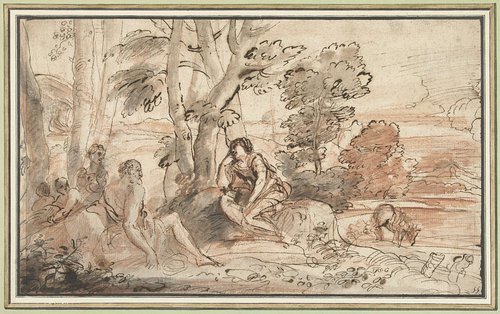
Ermina bij de herders
1622 - 1666
Medium
pen
Dimensions
347; 270
Rights
Public Domain
About this artwork
hoogte 270 mm x breedte 347 mm
Art Historical Context
**Ermina bij de herders** is a delicate pen drawing by Pier Francesco Mola, the Italian Baroque artist active in the 17th century (1622–1666). Measuring 270 mm high by 347 mm wide, this intimate work captures the poignant moment from Torquato Tasso's epic poem *Gerusalemme Liberata*, where the princess Erminia, disguised as a shepherdess, seeks refuge among humble herders amid her flight from war-torn lands. Mola, trained in Rome and influenced by Caravaggio's dramatic tenebrism and the Bolognese school's elegance, often explored literary and mythological themes in his oeuvre. Rendered in pen—likely ink on paper—this drawing exemplifies the preparatory precision of Baroque draftsmanship. Pen's fine lines allowed Mola to convey texture, movement, and emotion with economical strokes, a technique prized for studies that could inform larger oil paintings. Such works were highly valued in 17th-century Italy for their spontaneity and mastery of contour, bridging sketch and finished art. This piece reflects the era's fascination with Tasso's romantic heroism, blending pastoral idyll with underlying tension. As a rare surviving drawing by Mola, it offers visitors a window into the artist's process, highlighting Baroque art's fusion of narrative depth and technical virtuosity.
About the Artist
Pier Francesco Mola · 1612–1666
Pier Francesco Mola (1612–1666) was a Roman Baroque painter celebrated for the lyrical quality of his landscapes and the painterly freedom of his figural work, qualities that set him apart from the more rigorous classicism of some of his contemporaries. Born in Coldrerio in the Swiss canton of Ticino, he spent the greater part of his career in Rome, where he underwent an extensive and eclectic for...