
Errant pendant la nuit...
n.d.
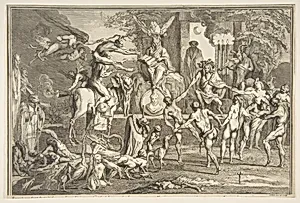
Medium
Etching, third state
Dimensions
image: 8 7/8 x 13 1/8 in. (22.5 x 33.4 cm), trimmed with inscription cut off
Classification
Prints
Department
Drawings and Prints
Museum
Metropolitan Museum of Art, New York, NY
Credit
The Elisha Whittelsey Collection, The Elisha Whittelsey Fund, 1957
Accession Number
57.581.36
Rights
Public Domain
Tags
Art Historical Context
Claude Gillot's *Errant pendant la nuit... (Wandering at Night...), an undated etching in its third state, captures the artist's playful yet masterful command of printmaking during the early 18th century. a French painter and engr (1673–1722), Gillot bridged the ornate Baroque era and the emerging Rococo style, influencing masters like Antoine Watteau, whom he briefly taught. This work, now housed in the Metropolitan Museum of's Drawings and Prints department, measures 8⅞ × 13⅛ inches and was acquired through The Elisha Whittelsey Collection in 1957. Notably trimmed, with its inscription lost, it exemplifies etching's intaglio technique, where acid etches intricate lines into a metal plate for richly textured prints. The composition bursts with Gillot's characteristic whimsy, featuring male and female nudes alongside animals and birds in a nocturnal scene suggested by the evocative title. These elements evoke mythological reveries or fantastical escapades, blending human forms with nature in a dynamic, almost theatrical interplay—hallmarks of Gillot's satirical and decorative flair, often inspired by commedia dell'arte. As a third-state impression, this print reflects refinements in the edition, showcasing evolving details that highlight etching's potential for nuance and depth. For visitors, it offers a window into French art's lively transition, where sensuality and fantasy danced under the cover of night.
About the Artist
Claude Gillot · 1673–1722
Artist known for his elegant designs done in the Rococo manner of Audran; also for his predilection for scenes from the 'comedia dell'arte.' Few paintings survive; his work is known mainly through drawings and etchings. Comment on works: Genre; History