
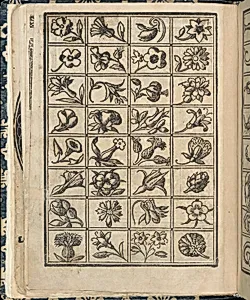
Essempio di recammi, page 10 (verso)
Medium
Woodcut
Dimensions
Overall: 7 13/16 x 6 3/16 x 3/8 in. (19.8 x 15.7 x 1 cm)
Classification
Books|Prints|Ornament & Architecture
Department
Drawings and Prints
Museum
Metropolitan Museum of Art, New York, NY
Credit
Harris Brisbane Dick Fund, 1935
Accession Number
35.75.3(20)
Rights
Public Domain
Tags
Art Historical Context
This woodcut page comes from *Essempio di recammi*, a 1530 embroidery pattern book authored by Giovanni Antonio Tagliente and printed in Venice by the da Sabio brothers. Measuring just under eight inches tall, the sheet belongs to one of the earliest printed manuals designed to guide needleworkers in creating decorative motifs. Its crisp black lines on paper capture the precision of the woodcut technique, which allowed intricate floral designs to be reproduced affordably for a growing audience of amateur embroiderers. In Renaissance Italy, such pattern books played an important role in spreading ornamental knowledge beyond court workshops. Tagliente’s publication offered practical models—here, delicate flowers—that could be transferred directly onto fabric for household linens, garments, and church vestments. The classification as both “Prints” and “Ornament & Architecture” reflects how these designs bridged the worlds of graphic art and applied decoration, influencing everyday objects as well as architectural embellishment. Today the page survives in the Metropolitan Museum’s collection thanks to the Harris Brisbane Dick Fund. Though only a single leaf, it offers visitors a tangible connection to the collaborative craft traditions of sixteenth-century Venice, where printed images helped transform personal needlework into a shared visual language.
About the Artist
Giovanni Antonio di Nicolini da Sabio e i fratelli|Giovanni Antonio Tagliente (Italian|Italian) · 1522 |1465 –1545 |1528
Italian, active Venice, ca. 1522–1545|Italian, Venice ca. 1465–1528 Venice