
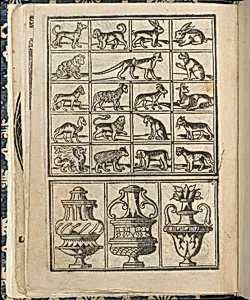
Essempio di recammi, page 11 (verso)
Medium
Woodcut
Dimensions
Overall: 7 13/16 x 6 3/16 x 3/8 in. (19.8 x 15.7 x 1 cm)
Classification
Books|Prints|Ornament & Architecture
Department
Drawings and Prints
Museum
Metropolitan Museum of Art, New York, NY
Credit
Harris Brisbane Dick Fund, 1935
Accession Number
35.75.3(22)
Rights
Public Domain
Tags
Art Historical Context
This woodcut page comes from *Essempio di recammi* (“Examples of Embroidery”), a pattern book published in Venice in 1530 by Giovanni Antonio Tagliente. Created as a practical guide for needleworkers, the volume offered ornamental motifs that could be transferred onto fabric. The verso of page 11 displays a lively assortment of creatures—dogs, rabbits, rams, camels, cats, horses, and fantastical dragons—arranged around classical urns, demonstrating the Renaissance fascination with both natural observation and imaginative invention. Printed from carved woodblocks, the image reflects the growing importance of printmaking in early modern Europe. Woodcuts allowed designs to be reproduced affordably and distributed widely, transforming embroidery from an exclusive courtly art into a more accessible domestic pursuit. Tagliente’s clear outlines and balanced compositions guided both professional artisans and amateur needlewomen in creating fashionable textiles for clothing and household furnishings. Today, this sheet in the Metropolitan Museum’s collection preserves a rare glimpse into the everyday creative process of the Renaissance. Its presence among the museum’s holdings of ornament and architecture highlights how functional pattern books shaped visual culture across media, from textiles to ceramics and architecture.
About the Artist
Giovanni Antonio di Nicolini da Sabio e i fratelli|Giovanni Antonio Tagliente (Italian|Italian) · 1522 |1465 –1545 |1528
Italian, active Venice, ca. 1522–1545|Italian, Venice ca. 1465–1528 Venice