
Etude (Maurice Dumont)
1895
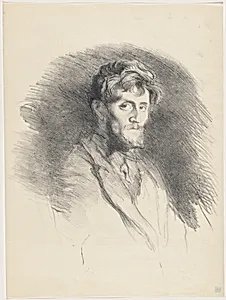
Medium
lithograph in black on thin japan paper
Classification
Department
CG-E
Museum
National Gallery of Art, Washington, D.C.
Credit
Virginia and Ira Jackson Collection, gift in memory of Virginia H. Jackson
Accession Number
1996.151.229
Rights
Public Domain
Art Historical Context
Henri de Groux's *Etude (Maurice Dumont)*, created in 1895, is a striking lithograph in black ink on delicate thin Japan paper. This intimate study captures the essence of its subject through the artist's masterful command of line and tone, exemplifying the Belgian Symbolist's flair for evocative portraiture. De Groux, a key figure in the Symbolist movement, often explored psychological depth and dreamlike intensity, bridging Realism and the emerging mysticism of fin-de-siècle Europe. Lithography, a revolutionary 19th-century technique allowing artists direct crayon or ink drawing on stone for multiple impressions, suited de Groux's expressive style perfectly. The choice of thin Japan paper—prized for its absorbency and subtle texture—enhances the print's velvety blacks and luminous whites, making it a collector's gem. Produced during a vibrant era of printmaking innovation, it reflects how artists like de Groux democratized access to original visions beyond paintings. Housed in the National Gallery of Art's Prints department (CG-E) as part of the Virginia and Ira Jackson Collection—gifted in memory of Virginia H. Jackson—this work invites visitors to ponder the personal narratives behind Symbolist portraiture, where a simple "study" reveals profound human mystery.