
European Landscape
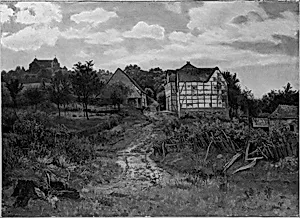
Classification
Painting
Department
Smithsonian Collection
Museum
Smithsonian American Art Museum
Credit
Hirshhorn Museum and Sculpture Garden, Smithsonian Institution, Washington, DC, Gift of Joseph H. Hirshhorn, 1966
Accession Number
66.507
Rights
Public Domain
About this artwork
Robert S. Sloan Gallery, New York, to 1964
Art Historical Context
Albert Bierstadt's *European Landscape* (c. 1856–1857) captures the artist's early fascination with the dramatic beauty of the Old World, painted during his formative years studying at the renowned Düsseldorf Academy in Germany. Born in Solingen, Germany, in 1830 and raised in New Bedford, Massachusetts, Bierstadt returned to Europe as a young man to hone his skills among leading landscapists. This work, created just before his rise to fame with monumental American wilderness scenes, reflects the influence of the Düsseldorf School's emphasis on meticulous detail, romantic light effects, and atmospheric depth—hallmarks that would define his later Hudson River School masterpieces. As a painting from Bierstadt's transitional period, *European Landscape* offers a glimpse into his evolving style, blending precise brushwork with a sense of sublime nature that evokes awe and tranquility. Though the exact medium remains unspecified, its classification as a painting underscores Bierstadt's commitment to capturing light's transformative power, a technique he perfected in oils to convey vastness and luminosity. Acquired by the Smithsonian American Art Museum through a gift from Joseph H. Hirshhorn in 1966—after passing through the Robert S. Sloan Gallery in New York—this piece enriches our understanding of Bierstadt's roots. It reminds visitors how an immigrant artist's European training fueled his iconic visions of America's untamed frontiers. (198 words)